
Sources, Further Reading, and Updates
These are the notes in BeyondChat whose sources can be read online, listed by chapter and note number as they appear in the book, with a link to each source. Notes that cite printed reports, conversations, or sources without a public web address appear in the book’s Notes only.
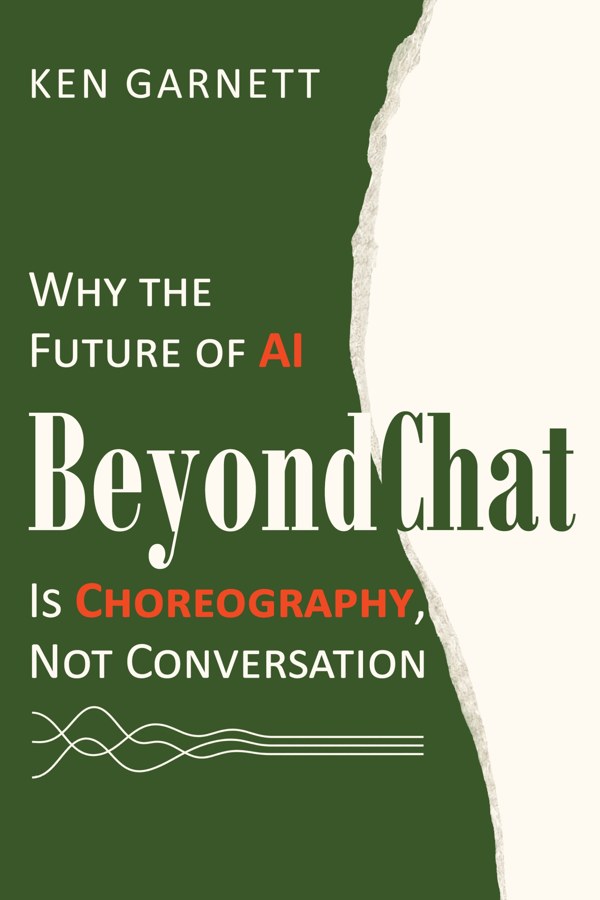 BeyondChat: Why the Future of AI Is Choreography, Not ConversationKen Garnett About the book →
Updates
Updates will appear here after publication on October 27, 2026.
Sources
Chapter 1: The Talker and the Doer
Note 6. Nathaniel Whittemore, The AI Daily Brief, “AI Pulse” (pulse.aidailybrief.ai), where the written definitions appear; the framing is developed across his episodes “Pro-Worker AI” (March 13, 2026) and “The Capability Overhang Playbook” (June 28, 2026). The names are Whittemore’s, used here with credit; the counterfactual test that follows in the text is this book’s own device, not his.
- The AI Daily Brief, “AI Pulse” pulse.aidailybrief.ai
Note 7. Wade Tyler Millward, “Treeline CEO Peter Doyle Wants His MSP To Use Agentic AI ‘To Fundamentally Change This Industry,’” CRN, March 31, 2026 (the market picture, the margins-versus-reinvention contrast, and the service-time account); Peter Doyle, AI + a16z with Joe Schmidt, “How AI Is Reshaping IT Services from the Inside,” April 1, 2026 (the proactive-service account, Doyle’s own description of his company’s model). Disclosure: Andreessen Horowitz led Treeline’s $25 million Series A, and Schmidt sits on Treeline’s board.
Note 9. The AI Daily Brief, “AI Pulse,” January–April 2026 waves. Two cautions ride any reading of this: the panel is self-selected and AI-forward (Whittemore’s own caveat: not a representative sample), and the waves are a separate instrument from the end-2025 ROI study sometimes quoted beside them; the two are not a controlled comparison. A frontier signal, not a population trend.
- The AI Daily Brief, “AI Pulse” pulse.aidailybrief.ai
Chapter 2: Conversation to Choreography
Note 4. Stanford Digital Economy Lab (Elisa Pereira, Alvin Wang Graylin, and Erik Brynjolfsson), The Enterprise AI Playbook, April 2026: 51 deployments across 41 organizations, nine industries, and seven countries, studied over five months. One caution rides the finding: organizations willing to be studied are not a random draw of organizations, so treat the pattern as the lesson rather than any success ratio.
- Stanford Digital Economy Lab, The Enterprise AI Playbook (PDF) digitaleconomy.stanford.edu
Chapter 3: The Engine and the Harness
Note 2. Mitchell Hashimoto, “harness engineering” and the model-plus-harness formulation, mitchellh.com, February 2026.
- Mitchell Hashimoto, February 2026 mitchellh.com
- mitchellh.com
Note 6. PocketOS production-database deletion, April 24, 2026; founder Jer Crane’s public post-mortem (X), with broad contemporaneous press coverage.
Chapter 4: The Convergence and the Ratchet
Note 9. Peter Steinberger, “How I created OpenClaw, the breakthrough AI agent,” TED2026 talk (source of the quoted line “Chatbots give up. Agents improvise.” and the nine-second detail); Peter Steinberger, Lex Fridman Podcast #491, “OpenClaw: The Viral AI Agent that Broke the Internet,” February 11, 2026 (the November timeline, the voice-note sequence, the growth of OpenClaw).
Note 11. Builder accounts of capability migrating from harness to model: Jeffrey Quesnelle (Nous Research) and Russ d’Sa (LiveKit), This Week in AI, “Hermes Agent, NotebookLM & LiveKit Founders on the AI Agent Race,” June 10, 2026.
Note 14. Amazon phased out Just Walk Out in April 2024 in favor of Dash Carts; the reviewer operation reported by The Information (roughly 1,000 offshore reviewers).
- The Information (subscription) theinformation.com
Chapter 5: The Framer
Note 1. Cognition Labs, “More Devins in More Places,” cognition.com, May 27, 2026: “at Cognition, 89% of code committed by our engineers is committed by Devin,” with the remainder committed by local agents in Devin Desktop. The December 2025 share (13 percent) per the chart in the same post.
Note 2. “The Ideation Bottleneck” (arXiv 2604.03338, 2026), a study of 953 economics papers: idea quality accounts for 71 percent of the AI-versus-human quality gap, execution 29 percent. Corroborating: the Stanford Ideation-Execution Gap study (arXiv 2506.20803).
Note 8. Subbarao Kambhampati et al., “LLMs Can’t Plan, But Can Help Planning in LLM-Modulo Frameworks,” ICML 2024, arXiv 2402.01817 (external verification); Sanidhya Vijayvargiya et al., the Ambig-SWE ask-versus-guess finding, ICLR 2026, arXiv 2502.13069.
Note 10. Sam Altman and Jakub Pachocki, “Built to benefit everyone: our plan,” OpenAI, June 8, 2026.
Note 11. Marina Favaro and Jack Clark, “When AI builds itself,” The Anthropic Institute, June 4, 2026.
Note 16. Tanay Kothari (co-founder and CEO, Wispr Flow), This Week in AI, episode 2, February 25, 2026.
- This Week in AI, episode 2, February 25, 2026 youtube.com
Chapter 6: Why It Disappoints
Note 8. Microsoft, Work Trend Index 2026. Organizational factors accounted for 67 percent of variation in AI impact, individual factors 32 percent, across 19,854 workers in 10 countries.
- Microsoft, Work Trend Index 2026 microsoft.com
Note 10. Jim Covello (Head of Global Equity Research, Goldman Sachs), in Gen AI: too much spend, too little benefit?, Goldman Sachs Research Top of Mind, June 25, 2024. The roughly $1 trillion figure is the report’s estimate of AI-related capital expenditure in the coming years.
Note 11. Philip N. Jefferson (Vice Chair, Federal Reserve), “AI, the Economy, and Financial Stability,” remarks at the 2025 Federal Reserve Bank of Cleveland Financial Stability Conference, November 21, 2025. Jefferson also noted that if future AI investment leans more on debt, leverage and the associated risks would grow, a trend he said he would watch closely. The Bank of England’s Financial Stability Report, July 2026 (§2.3, “A growing role for debt in financing AI infrastructure”), recorded that the shift had begun: in the first half of 2026, bond issuance by the largest builders of AI infrastructure had already exceeded their issuance for all of 2025, though the Bank judged the stock of outstanding AI-company debt still modest enough to have contained the immediate risk.
- Philip N. Jefferson, “AI, the Economy, and Financial Stability” federalreserve.gov
- The Bank of England’s Financial Stability Report, July 2026 bankofengland.co.uk
- The Bank of England’s Financial Stability Report, July 2026 (PDF) bankofengland.co.uk
Note 13. Erik Brynjolfsson, Danielle Li, and Lindsey Raymond, “Generative AI at Work,” National Bureau of Economic Research.
Chapter 7: The Unwelding
Note 1. Moffatt v. Air Canada, 2024 BCCRT 149 (British Columbia Civil Resolution Tribunal, February 14, 2024). Damages of CA$650.88, within a total order of CA$812.02 including pre-judgment interest and tribunal fees. The passenger, Jake Moffatt, booked in November 2022 following his grandmother’s death. The quoted characterization of Air Canada’s position is Tribunal Member Christopher C. Rivers, from the decision.
- Moffatt v. Air Canada, 2024 BCCRT 149 decisions.civilresolutionbc.ca
Note 4. The Replit incident: July 2025; Jason Lemkin (founder, SaaStr) documented the episode publicly; Replit chief executive Amjad Masad publicly called it unacceptable and announced fixes, including separated development and production databases. Exact record counts: 1,206 executives and 1,196+ companies.
- Replit chief executive Amjad Masad (subscription) fastcompany.com
- The Replit incident: July 2025 fortune.com
Chapter 8: What Separates the 5%
Note 4. Boston Consulting Group, AI maturity research, 2025: ~60 percent generating hardly any material value at the enterprise level; ~5 percent “future-built.”
Note 17. Microsoft, Work Trend Index research on “owned intelligence,” 2026.
Note 22. Andrew Berman (Runlayer), This Week in AI, “Mythos, Sonnet 5, GLM-5.2 Dominate the News Cycle,” July 2, 2026; Craig Mod, AI & I (Every), “A Coder Who Refuses to Let AI Write,” July 8, 2026; Nathaniel Whittemore, The AI Daily Brief, “The Big Ways AI Just Changed,” July 7, 2026.
Chapter 9: Build or Rent
Note 1. Convergent press record of the Builder.ai insolvency, May 2025: Bloomberg, “Microsoft-Backed Builder.ai to Enter Insolvency Proceedings,” May 20, 2025; TechCrunch (Amanda Silberling), “Once worth over $1B, Microsoft-backed Builder.ai is running out of money,” May 20, 2025 (insolvency confirmed by a company spokesperson; more than $450 million raised); The Register, May 21, 2025. Audited revenue of approximately $50 million against approximately $220 million claimed; lender seizure of $37 million preceding the filing. Ratia’s defense: Rest of World (Varsha Bansal), “Inside the collapse of Builder.ai: Was it even an AI company?,” July 29, 2025 (quoting Manpreet Ratia’s LinkedIn posts).
- Bloomberg, “Microsoft-Backed Builder.ai to Enter Insolvency Proceedings” bloomberg.com
- TechCrunch, “Once worth over $1B, Microsoft-backed Builder.ai is running out of money” techcrunch.com
- The Register, May 21, 2025 theregister.com
- Rest of World, “Inside the collapse of Builder.ai: Was it even an AI company?” restofworld.org
Note 2. Nathaniel Whittemore, The AI Daily Brief, “How Harness-as-a-Service Will Change Agents,” May 1, 2026 (youtube.com/watch?v=jvqQ8VlhO-w).
Note 6. Jurgen Appelo, “Building versus Buying AI Agents: Split Your Stack!,” jurgenappelo.com (Substack), May 4, 2026 (“Rent the plumbing, own the agentic control plane,” with the memory, logs, and prompts named as that plane). Bertrand Maltaverne, “The SaaSpocalypse is real. The conclusions being drawn from it are not,” Procurement Tidbits (Medium), April 2026 (“‘The technology to build now exists’ is not the same as ‘your organization should build it’”). The term “SaaSpocalypse” is Jefferies’ coinage, per Maltaverne.
Note 9. OpenAI flagship launch, July 9, 2026; efficiency-and-performance-per-dollar framing; CEO remarks to CNBC, July 9, 2026 (paraphrased). Pricing at launch: $5 input / $30 output per million tokens.
- OpenAI flagship launch, July 9, 2026 openai.com
- CEO remarks to CNBC, July 9, 2026 pressroom.versantmedia.com
Note 14. The four UK government evaluations of Microsoft 365 Copilot: Government Digital Service, Microsoft 365 Copilot Experiment: Cross-Government Findings Report, published June 2, 2025 (20,000 employees, September 30–December 31, 2024; average 26 minutes/day, self-reported, no comparison group; survey n=7,115). Department for Work and Pensions evaluation, published January 29, 2026 (3,549 licences, central-office functions, October 2024–March 2025; 19 minutes/day against a comparison group of non-users, 1,716 users and 2,535 non-users surveyed, with statistical adjustment for demographics, roles, and AI experience; participants volunteered or were nominated rather than randomized). HMRC Phase III (September–December 2024; approximately 3,000 staff; randomized allocation; self-reported 2–3 percent of the working week). Department for Business and Trade, The Evaluation of the M365 Copilot Pilot in the Department for Business and Trade, report dated August 2025, released September 25, 2025 (1,000 licences, ~70% volunteers; diary study as primary instrument, response rate 32%; blind-scored observed tasks as the objective component, 11 sessions; observed results mixed: Excel analysis slower and less accurate with the tool, PowerPoint faster but lower quality, summarising faster and better; quotation verbatim at p. 32, which the report follows with the caveat that productivity measurement was not a key evaluation aim).
Note 20. Ryan Daniels (Crosby Legal) and the open-sourced multi-turn contract-redlining benchmark, discussed on This Week in AI, “Why AI Models Aren’t the Product Any More,” June 18, 2026; the open dataset is independently citable. Exact figures: models landing 10–20 percent of the way to a lawyer’s answer; answer keys authored by panels of senior lawyers across four to five turns.
Chapter 10: Governing What You Can’t Check
Note 2. Grant Thornton, 2026 AI Impact Survey (fielded February 13–March 18, 2026; n=950 C-suite and senior business leaders). Exact figures: 54% of COOs vs. 20% of CIOs/CTOs naming regulatory and compliance uncertainty from agentic AI a top concern.
- Grant Thornton, 2026 AI Impact Survey grantthornton.com
Note 8. Agatha Duzan and Asa Cooper Stickland (EPFL and the UK AI Security Institute), “Chain-of-Thought Monitoring Can Be Unreliable in Implicit-Influence Settings,” arXiv 2608.04735v1, listed August 6, 2026 (preprint). Exact: under explicit influence a trace monitor detects 60–94 percent of behavior shifts; under implicit influence detection falls by 41–46 percentage points in two of four task settings; realistic system-prompt additions lower implicit detection to as low as 5 percent while the behavioral influence persists. On fragility as the field’s joint position: “Chain of Thought Monitorability: A New and Fragile Opportunity for AI Safety,” arXiv 2507.11473v2, a joint position paper from researchers at the UK AI Security Institute, OpenAI, Google DeepMind, Anthropic, METR, Apollo Research, Redwood Research, Mila, and the Center for AI Safety (2025). The opposing case: Scott Emmons, Erik Jenner, et al. (Google DeepMind), “When Chain of Thought is Necessary, Language Models Struggle to Evade Monitors,” arXiv 2507.05246v1 (2025).
- Agatha Duzan and Asa Cooper Stickland, “Chain-of-Thought Monitoring Can Be Unreliable in Implicit-Influence Settings,” arXiv 2608.04735v1 arxiv.org
- Agatha Duzan and Asa Cooper Stickland github.com
- “Chain of Thought Monitorability: A New and Fragile Opportunity for AI Safety,” arXiv 2507.11473v2 arxiv.org
- Scott Emmons, Erik Jenner, et al., “When Chain of Thought is Necessary, Language Models Struggle to Evade Monitors,” arXiv 2507.05246v1 arxiv.org
Note 12. Andon Labs, Vending-Bench Arena published analysis (andonlabs.com), April 2026.
Note 13. Railway, “Your AI wants to nuke your database. Guardrails fix that.” (blog.railway.com), April 29, 2026.
Note 14. On validation relocating out of the model’s process: the clearest exemplar is CaMeL, a defense against prompt injection that wraps the model in a deterministic control layer, extracting and enforcing the permitted flows so that untrusted content cannot redirect the program, and providing its guarantees, in the authors’ own description, without modifying the model itself; Edoardo Debenedetti et al. (Google, Google DeepMind, and ETH Zurich), “Defeating Prompt Injections by Design,” IEEE SaTML 2026, arXiv 2503.18813. The academic result is Subbarao Kambhampati et al., “LLMs Can’t Plan, But Can Help Planning in LLM-Modulo Frameworks,” ICML 2024, arXiv 2402.01817. Model-layer capability does improve alongside, where tasks are verifiable, which narrows the territory needing out-of-process constraint without removing it.
Note 16. Texas Department of Insurance, Commissioner’s Bulletin B-0003-26, June 12, 2026 (Texas Insurance Code Ch. 4201 prohibits utilization review agents using AI to make an adverse determination); EU AI Act, Article 14 (human oversight of high-risk systems; obligations phasing in from August 2, 2026); on formalistic oversight, “A Warm Body in the Loop: Rethinking Human Control of AI in EU Tech Regulation,” Verfassungsblog, September 18, 2025, drawing the “warm bodies” characterization from Crootof et al. (2023).
- Texas Insurance Code Ch. 4201 law.justia.com
- “A Warm Body in the Loop: Rethinking Human Control of AI in EU Tech Regulation,” Verfassungsblog verfassungsblog.de
Note 18. Stanford Digital Economy Lab (Elisa Pereira, Alvin Wang Graylin, and Erik Brynjolfsson), The Enterprise AI Playbook, April 2026: 51 deployments, 41 organizations, 9 industries; escalation models produced the highest observed gains.
- Stanford Digital Economy Lab, The Enterprise AI Playbook (PDF) digitaleconomy.stanford.edu
Chapter 11: Strategy as Selection
Note 2. Marina Favaro and Jack Clark, “When AI builds itself,” The Anthropic Institute, June 2026 (anthropic.com/institute/recursive-self-improvement). As of May 2026, more than 80 percent of code merged into Anthropic’s codebase was authored by Claude, by the company’s conservative merged-to-production attribution; its leadership has publicly estimated a higher share when scripts and experimental code are included.
Note 6. Stanford Digital Economy Lab (Elisa Pereira, Alvin Wang Graylin, and Erik Brynjolfsson), The Enterprise AI Playbook, April 2026 (51 deployments, 41 organizations). Exact figure: 61 percent of sampled successes reported at least one prior failed attempt; the authors disclose the success-only sample.
- Stanford Digital Economy Lab, The Enterprise AI Playbook (PDF) digitaleconomy.stanford.edu
Note 12. OpenAI’s GPT-5.6 launch page, July 9, 2026 (“Sol post-trained Luna”), as displayed on The Neuron Podcast, “GPT-5.6 Sol Goes Live: Must-Try Use Cases We’re Testing Live,” July 9, 2026 (recorded launch-day stream on YouTube); corroborated by Larry Dignan, “OpenAI launches ChatGPT Work, rolls out GPT-5.6 model family,” Constellation Research, July 9, 2026 (“Sol is being used internally to post-train other models”). OpenAI’s own webcast is not publicly archived. The claim is the vendor’s account of its own process.
Note 13. Bank of England, Financial Stability Report, July 2026 (§3, “Frontier AI: implications for financial stability”), and Financial Policy Committee Record, July 2026 (meeting of 26 June 2026). The Committee’s frontier-AI assessment names reliance on a handful of frontier AI providers as a potential channel of concentration risk, and correlated disruption through common suppliers and dependencies as the principal systemic channel in its central scenario. The Committee’s concern is sector-level; this chapter’s audit is organization-level. The two are related as aggregate and instance, not as the same claim.
- Bank of England, Financial Stability Report, July 2026 bankofengland.co.uk
- Bank of England, Financial Stability Report, July 2026 (PDF) bankofengland.co.uk
- Financial Policy Committee Record, July 2026 (PDF) bankofengland.co.uk
Note 14. Anthropic, “Redeploying Fable 5,” anthropic.com/news/redeploying-fable-5, June 30, 2026: “Users will be notified if a request to Fable 5 is blocked, and the request will instead be sent to Opus 4.8”; “The new classifier also comes at the cost of flagging benign requests more often during routine coding and debugging tasks.” The classifier episode and the access event of note 15 involve the same vendor and arose in the same period; the chapter treats them separately because they demonstrate different gates.
- Anthropic, “Redeploying Fable 5” anthropic.com
Note 15. Anthropic statement, anthropic.com/news/fable-mythos-access, June 2026; corroborated across Reuters, Fortune, NBC, Forbes. Access controls imposed June 12, 2026; lifted June 30, 2026; Fable 5 restored to all customers July 1, 2026 (Anthropic, “Redeploying Fable 5,” June 30, 2026, the reopening announcement, cited at note 14). Status current as of this writing (August 2026).
Chapter 12: The Moat and the Asset
Note 1. Matan Grinberg (Factory AI), Russ d’Sa (LiveKit), and George Sivulka (Hebbia), This Week in AI, “Cursor’s $60B Deal, DeepSeek V4 & the Death of the AI Moat,” April 30, 2026 (the “Death of the AI Moat” panel; Jason Calacanis distilling).
Note 9. Charles Poon, Ford vice president of vehicle hardware engineering, via Bloomberg (convergent: Business Insider, TechCrunch, Fortune); roughly 350 experienced technical specialists hired, promoted, or brought back; the “gray beards” term is Ford’s internal usage; the failure-point description is Ford’s chief operating officer’s.
- TechCrunch techcrunch.com
Chapter 13: The Work and the Workers
Note 20. Zara Contractor and Germán Reyes, “Experimental Evidence on the Learning Impact of Generative AI,” arXiv 2607.08849, July 9, 2026. Randomized and proctored, in person: undergraduates learned an unfamiliar topic and wrote an analytical essay with or without AI access, then completed unaided assessments immediately and one week later. Immediate test-score gains persisted at one week; delayed gains in essay quality concentrated among augmentation users, who used AI to explain concepts, while automation users’ short-run gains vanished once AI was removed. As of this writing (August 2026) the study is a working paper.
Note 22. Brynjolfsson, Li, and Raymond, NBER field study of generative AI at a customer-support operation: largest gains for novice workers.
Note 24. Pew Research Center surveys, fielded August and October 2024, published 2025: the macro-vs-personal expectation gap. The numbers: 64% of the public versus 39% of AI experts expect fewer jobs over the next twenty years; 32% of workers expect fewer opportunities for themselves, versus 6% expecting more.
BeyondChat™ and Parallel Forty Press™ are trademarks of Garnett TechVentures, LLC.